Vaccination Schedule for Horses

| Age | Tetanus | 2-way OR 3-way Sleeping Sickness | West Nile Virus | Rabies | RHINO (EHV) Respiratory | RHINO (EHV) Abortion | Influenza | Potomac Horse Fever | Strangles |
|---|---|---|---|---|---|---|---|---|---|
| Adult Horse Booster Series | Tetanus: annually or following injury | 2-way: or 3-way Sleeping Sickness: annually | West Nile Virus: annually | Rabies: annually | Rhino (EHV) Respiratory: annually | Rhino (EHV) Abortion: annually | Influenza: semi-annually to annually | Potomac Horse Fever: semi-annually to annually | Strangles: semi-annually to annually |
| Adult Horse Primary Vaccinations | Tetanus: 2-dose series | 2-way or 3-way Sleeping Sickness: 2-dose series | West Nile Virus: single dose or 2-dose series | Rabies: single dose | Rhino (EHV) Respiratory: 3-dose series | Rhino (EHV) Abortion: 3-dose series | Influenza: 1-dose, 2-dose or 3-dose series | Potomac Horse Fever: 2-dose series | Strangles: 2-dose or 3-dose series |
| Broodmare Booster Series | Tetanus: annually, 4-6 weeks pre-partum | 2-way or 3-way Sleeping Sickness: annually, 4-6 weeks pre-partum | West Nile Virus: annually, 4-6 weeks pre-partum | Rabies: annually, pre-partum or pre-breeding | Rhino (EHV) Respiratory: 3-dose series | Rhino (EHV) Abortion: 3-dose series | Influenza: semi-annually, with one dose given 4-6 weeks pre-partum | Potomac Horse Fever: semi-annually, with one dose given 4-6 weeks pre-partum | Strangles: semi-annually, with one dose given 4-6 weeks pre-partum |
| Broodmare Primary Vaccinations | Tetanus: 2-dose series | 2-way: or 3-way Sleeping Sickness: 2-dose series | West Nile Virus: Not recommended unless high risk. | Rabies: single dose, pre-partum or pre-breeding | Rhino (EHV) Respiratory: 3-dose series | Rhino (EHV) Abortion: 3-dose series | Influenza: 2-dose or 3-dose series | Potomac Horse Fever: 2-dose series | Strangles: 3-dose series |
| Foal | Tetanus: 3-dose series | 2-way: or 3-way Sleeping Sickness: 3-dose or 4-dose series | West Nile Virus: 2-dose or 3-dose series | Rabies: single dose or 2-dose series | Rhino (EHV) Respiratory: 3-dose series | Rhino (EHV) Abortion: 3-dose series | Influenza: 2-dose or 3-dose series | Potomac Horse Fever: 2-dose series | Strangles: 3-dose series |
Prepared using vaccination guidelines developed by the American Association of Equine Practioners Infectious Disease Committee, 2008.
Many combination vaccines are available, with protection against multiple diseases, to minimize the number of injections given.
Common Equine Diseases
Tetanus
Often referred to as “lockjaw”, tetanus is caused by a toxin-producing bacterium that is often found in the soil. It can enter the skin through cuts, wounds or a newborn’s umbilicus. Symptoms include muscle stiffness and rigidity, flared nostrils, prolapsed third eyelid and legs stiffly held in a sawhorse stance. As the disease progresses, muscles in the jaw and face stiffen, preventing the animal from eating or drinking. More than 80% of affected horses die.
Encephalomyelitis
More commonly known as “sleeping sickness”, this virus is transmitted to horses by mosquitoes that have acquired it from birds and rodents. Eastern (EEE) and Western (WEE) equine encephalomyelitis have been noted in the United States. Venezuelan (VEE) equine encephalomyelitis has not been seen in the U.S., however a recent outbreak occurred in Mexico. Symptoms vary, but all result from degeneration of the brain. Early signs include fever, depression and loss of appetite. As it progresses, staggering gait and paralysis may develop. Depending upon the strain, between 20 and 100% of infected horses die.
West Nile Virus
A virus transmitted by mosquitoes that have acquired it from birds or other animals. West Nile Virus infects the central nervous system, and presents with symptoms similar to Encephalomyelitis. Although it has been responsible for equine deaths, most infected horses can achieve full or partial recovery with supportive therapy.
Rabies
The rabies virus is most often transmitted through contact with the saliva of an infected animal. Rabies affects the central nervous system and leads to cerebral dysfunction, including excess salivation, abnormal behavior and aggression. Though horses are infected infrequently, it is always fatal. Rabies can be transmitted from horses to humans.
Equine Herpesvirus/Rhinopneumonitis (EHV)
Two distinct viruses, equine herpesvirus type 1 (EHV-1) and equine herpesvirus type 4 (EHV-4) cause two different diseases, both of which are known as rhinopneumonitis. Both types cause respiratory problems that may include fever, lethargy, loss of appetite, nasal discharge and coughing. EHV-1 may also cause abortion, foal death, neurological signs and paralysis. Rhinopneumonitis is spread by aerosol or direct contact with secretions, instruments or drinking water. The virus may not present any symptoms in carrier animals. Immune protection for pregnant mares requires vaccination with EHV-1 vaccine specifically labeled for abortion protection.
Influenza
One of the most common respiratory diseases in horses, influenza is highly contagious. The virus can be transmitted by aerosol transmission from horse to horse. Symptoms are similar to those in a human with a cold, including dry cough, nasal discharge, fever and loss of appetite. Horses that travel or are exposed to other horses are most at risk.
Potomac Horse Fever
An acute enterocolitis caused by ingestion of bacterial spores that may be found in pastures bordering creeks and rivers. Symptoms can include mild colic, fever, diarrhea and abortion. PHF is a seasonal problem with geographic factors.
Strangles
A highly contagious, yet rarely fatal, bacterial infection characterized by abscess of the lymphoid tissue of the upper respiratory tract. Strangles is transmitted through contact with infectious excretions and surfaces containing the resilient bacteria.
Resources: American Academy of Equine Practitioners, Bayer Animal Health, the Merck Veterinary Manual and the Centers for Disease Control and Prevention.
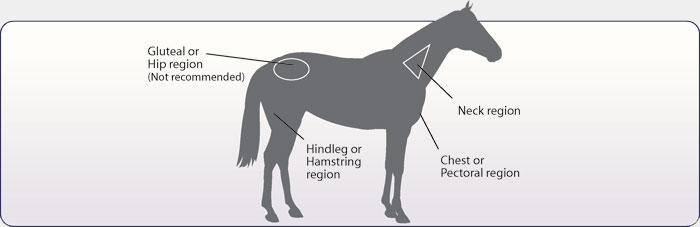
Equine Injection Guide